

Impact Investing Update - Fall 2026
Welcome to Nixon Peabody Trust Company’s inaugural NP Sustainable Impact Update. The Sustainable Impact program at Nixon Peabody Trust Company helps clients put assets into action in support of a more sustainable, equitable world.
Our law firm, Nixon Peabody LLP, has provided financial advice since the mid-1800s, when our lawyers served as trusted advisors to wealthy merchants. Over the years, many of our clients have looked to make investments that reflect their values. We have developed a suite of investment options to provide diversified exposure to companies with strong sustainability profiles as well as high-impact investments, such as community investment loan funds. In this edition, we highlight some of our recent work.
Nixon Peabody Trust Company Sponsors US SIF Peter DeSimone Scholars
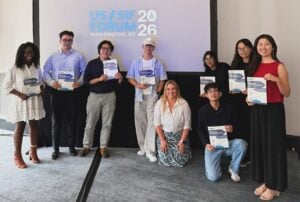
Peter DeSimone scholars with Jennifer Coombs (center), head of content and development for US SIF.
In June, Nixon Peabody Trust Company was pleased to sponsor the US SIF Peter DeSimone Scholars, a group of next-generation impact leaders, announced at the organization’s annual conference in Washington, DC. US SIF is the member association for sustainable and impact investing in the US. The scholarship—which honors the legacy of former US SIF employee and advocate for sustainable investing Peter DeSimone—expands access to education, training, and networking experiences for recent graduates. It also provides funding for scholars to attend the annual conference. With a focus on diversity, the scholarship reduces barriers to entering the impact industry and helps foster a more inclusive and informed financial industry committed to long-term, responsible outcomes. Congratulations to the scholars!
- Yanjinlkham Gima, Michigan State University
- Nhan Han, Lewis & Clark College
- Mona Kaur, Bard College
- Inho Lee, Columbia University
- Tracey M., Columbia | SIPA
- Ayako Takao, Johns Hopkins School of Advanced International Studies (SAIS)
- Baljinnyam Tovuudorj, Questrom School of Business, Boston University
- Zhen Z., Harris School of Public Policy at the University of Chicago
Sustainable Solutions Strategy Update
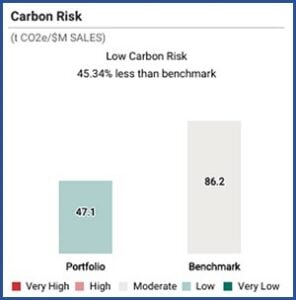
Graph: NP Sustainable Impact model vs. the iShares Core S&P 500 ETF, MSCI Data,10/9/26.
Sustainable Solutions is a fossil-fuel-free diversified stock portfolio that we created for our clients who embrace environmental, social, and governance (ESG) and impact investing. The portfolio serves as a core equity allocation providing direct exposure to large-cap stocks within a broader portfolio of mutual funds and ETFs. In addition to identifying companies with strong overall ESG characteristics, the portfolio also proactively includes companies that are providing solutions to sustainability challenges, such as water scarcity, renewable energy, energy efficiency, and sustainable agriculture. Our Solutions companies include: First Solar (thin film solar), HASI (renewable energy financing), and Itron (water and energy metering and efficiency). We recently completed an impact assessment of the portfolio using data from MSCI and found that the portfolio is 45% more carbon efficient than the benchmark S&P 500. This means that across the portfolio we have lower exposure to companies with high carbon emissions that contribute to our warming planet. Let us know if you would like to incorporate Sustainable Solutions as part of your portfolio allocation.
Introducing Jonathan TerMeer
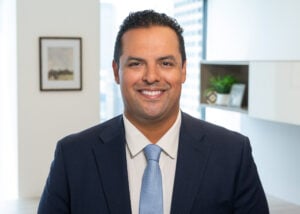
Jonathan TerMeer Business Development Director, Trust Services, Nixon Peabody Trust Company
Jonathan TerMeer has joined Nixon Peabody Trust Company as our new business development director. Jonathan has more than a decade of experience in wealth management and impact investing. Most recently, he served as an investment portfolio manager and wealth advisor at Washington Trust Wealth Management, where he worked with individuals and high-net-worth families to align their values with long-term investment objectives. Prior to that, he led the Northeast office for TriLinc Global Advisors, an impact investment management firm, partnering with family offices, foundations, endowments, and their advisors to advance their impact missions and investment goals. Jonathan is a frequent speaker at sustainable and impact investing conferences and a university guest lecturer on the topic.
“Impact investing is a powerful way to help solve some of the biggest challenges we face around energy, climate, and social inequality. It’s also a way to engage the next generation and carry on a family legacy beyond philanthropy,” Jonathan said. “Sustainable and impact investments have come a long way, and firms like Nixon Peabody Trust Company are leading the charge. Gone are the days when investors had to sacrifice returns to align their values with their investments.”
Amber Farmland Investments: Building the Organic Future
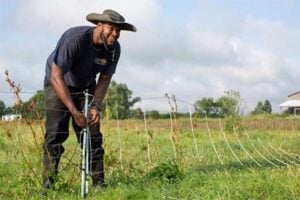
Photo: Justin Butts, Black Wind Farm. Photo courtesy of Amber Farmland Investments.
One of our high-impact investment options is Amber Farmland Investments, a farmland REIT partnering with farmers across the United States to simplify the transition of conventional farmland to USDA-certified organic. Founded in 2007 and formerly known as Iroquois Valley Farmland REIT, Amber is a Public Benefit Corporation and Certified B Corporation delivering sustainable impact for investors and farmers alike.
Nixon Peabody Trust Company’s Director of Business Development, Jonathan TerMeer, sat down with Amber’s CEO Chris Zuehlsdorff to learn about the company’s vision and impact.
So, how does Amber work?
Amber raises capital from individual and institutional investors and uses it to acquire farmland in partnership with experienced organic farmers. Investors benefit from two primary potential sources of return: lease income and farmland appreciation.
As a perpetual-life REIT, Amber holds farmland while farmers operate through long-term, evergreen leases. This structure gives farmers the stability and financial runway to transition land from chemical-dependent to organic production, while giving investors access to farmland as a real asset. Amber’s farmland hub investment strategy also concentrates investments in regions with strong potential for organic agriculture to thrive.
Importantly, Amber’s approach always starts with the farmer—specifically experienced growers seeking a long-term capital partner. Farmers know their land and understand their markets. By bringing in Amber, they align their long-term interests with those of the investors and the land itself.
How does Amber measure its impact?
Investment impact is measured across six environmental, social, and economic impact pillars. Some of these metrics include acres transitioned to or maintained as USDA-certified organic farmland, improvements in soil health, reduced reliance on synthetic pesticides and fertilizers, biodiversity and water conservation, carbon sequestration, and the economic longevity of the farming businesses it supports.
Since 2014, Amber farmers have eliminated 29 million pounds of synthetic chemicals from the food system, prevented 95,000 tons of topsoil erosion, sequestered 100,000 metric tons of CO₂, and retained 700 million gallons of water.
What distinguishes Amber’s model against competitors?
The impact of Amber’s model is best exemplified through the farmers it supports. To effectively remove barriers to organic farming, creating durable relationships between investors, farmers, and the land is essential. Amber’s investment model supports these partnerships: investors provide the capital, farmers put it to work on the land, and Amber’s structure facilitates long-term results.
As the current generation of farmers approaches retirement, an estimated 40% of US farmland is expected to change hands over the next 15 years. At the same time, demand for organic products in the US is growing, and organic farmers are seeking to expand their land. Amber capitalizes on both consumer demand and generational farmland transfer to enable investors to improve the health of our agricultural system, communities, and planet.
Can you provide an example of a farm you have helped?
Justin Butts of Black Wind Farm is a chef, Navy veteran, and first-generation farmer raising Kunekune pigs, cattle, sheep, and goats in the rolling hills of upstate New York. Justin’s path to the land was anything but straightforward. He began growing food alongside his grandfather as a child, lost his family home during the housing crisis at 17, and served six years in the Navy before an injury led to an early military retirement. He returned home determined to farm, training in both conventional and organic agriculture while building his culinary skills and raising his own livestock, laying the groundwork for what would become Black Wind Farm.
When an abandoned organic cattle farm became available through the Local Farms Fund, Justin stepped forward and Amber stepped in. Traditional financing wasn’t an option, as VA loans don’t support commercial farms and conventional banks often require down payments well beyond the reach of new livestock farmers. With investor support from Amber’s Rooted in Regeneration Notes, Justin secured the financing to purchase the land and establish a permanent home for his operation. Today, he stewards that land using rotational grazing and organic, regenerative practices, cultivating healthy animals, thriving pastures, and fields rich with native forage that supports pollinators and birds alike. Alongside his grazing operation, he hosts on-farm butchery workshops and a seasonal farm-to-table dinner series, all in service of his vision for a food system rooted in resilience, animal welfare, and a deeper connection between people and the land.
Key contact:
If you would like to add Amber Farmlands to your investments or have questions about other NP High Impact Investing options, contact Paul Hilton at philton@nixonpeabody.com